
Examples
Live applications running on Ferrite
When engineers hear that every Ferrite application compiles against a single dependency with no shell, no host file system and no open sockets, the first question is whether that boundary fits only small prototypes. Open the products on this page to judge for yourself. They span a full macOS Catalina desktop rebuilt for the browser with 49 applications, a studio timetable booked by both people and their AI assistants, four familiar Next.js applications brought over with their React components intact, an equipment store with Stripe checkout, and a version-checked review room for teams. Every one runs as an ordinary Ferrite application under the same default isolation.
Macalicious
A macOS Catalina desktop rebuilt for the browser
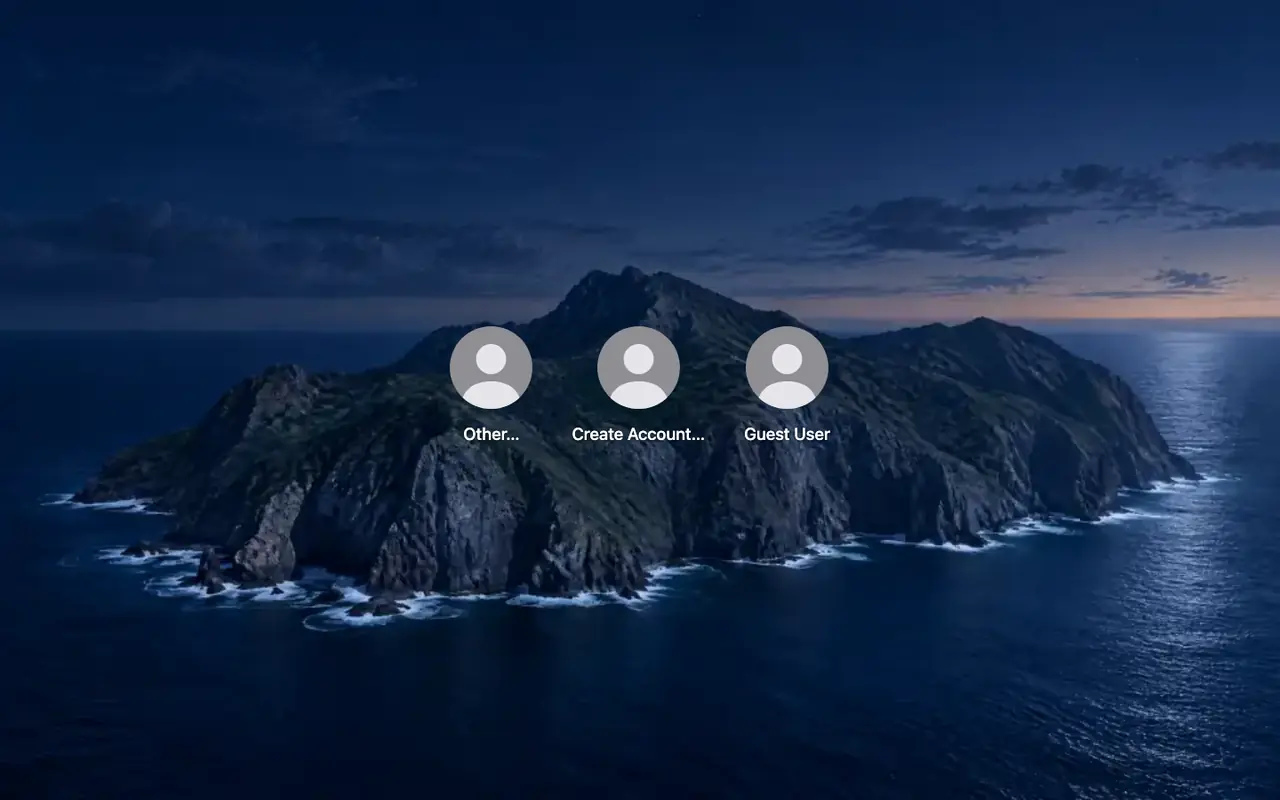
Macalicious answers the ceiling question first. It recreates the macOS Catalina desktop in the browser with overlapping windows, a Dock, a menu bar, a login screen and 49 working applications. Choose Guest User at login to explore it immediately without registering. Every line of application logic is freshly written, and user accounts, saved files, preferences and application state all live inside one Ferrite deployment.
Running 49 applications, personal accounts and a durable file drive inside a single constrained binary proves that strict containment leaves full room for ambitious software. Macalicious receives the same isolation, capability checks and outbound limits as a single-endpoint counter, with no custom infrastructure or security wiring.
Yoga booking
One studio timetable for human customers and their AI assistants
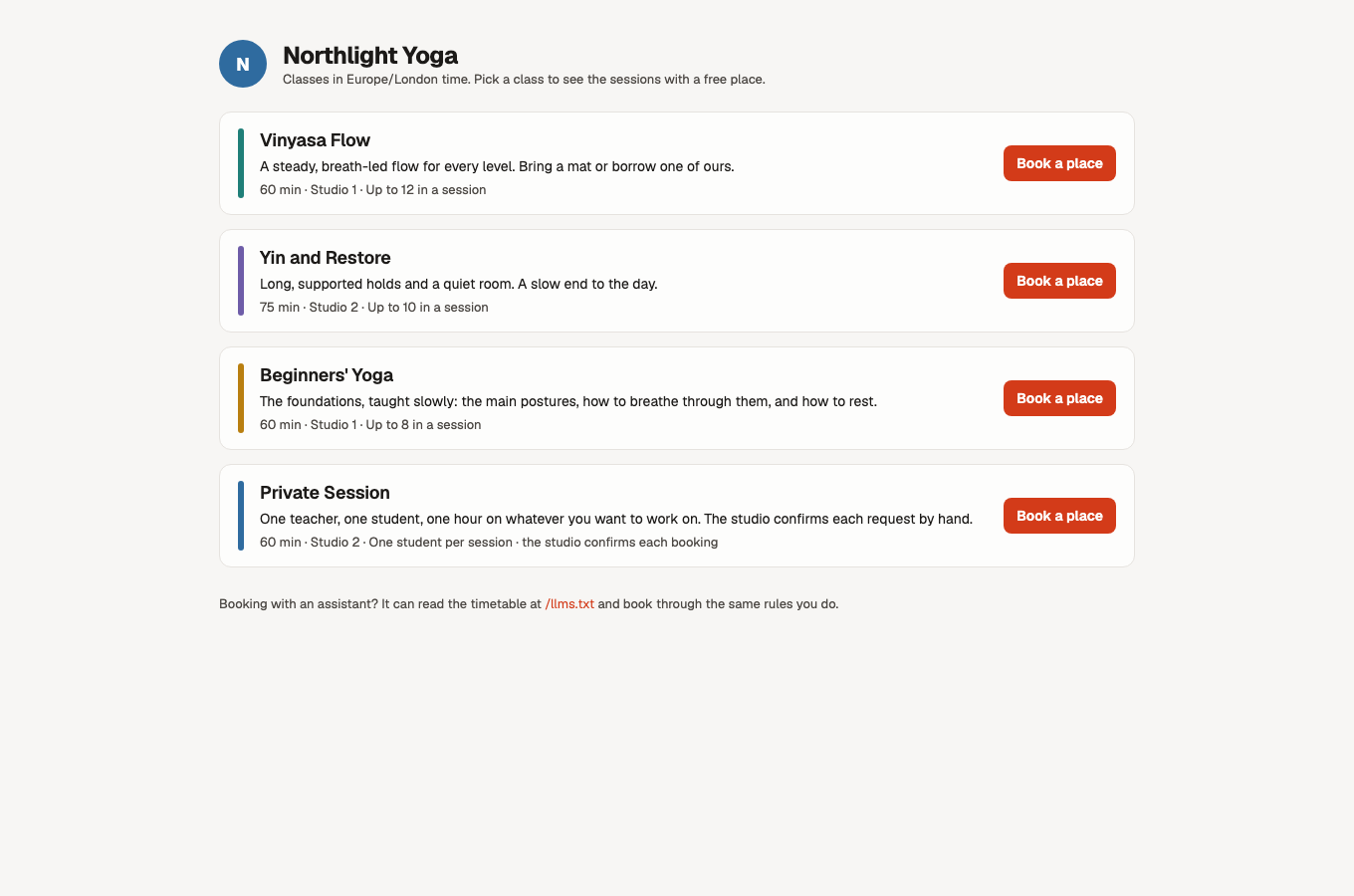
Northlight Yoga puts Ferrite's two-sided product model to work on real scheduling rules. The studio publishes class types, weekly times and fixed room capacities. Visitors book in a browser without creating an account, while customers using ChatGPT, Claude or another AI assistant ask their assistant to inspect the schedule and reserve a place. Both paths call the same server operations against one live calendar.
Operational edge cases behave the way a working venue expects. A five-minute seat hold is stored durably and outlasts restarts, while compare-and-set seat allocation stops two concurrent requests from selling the final spot twice. Cancelling a booking releases the place to the earliest matching entry on the waitlist, and background jobs prepare pre-class reminders automatically. Staff sign-in gates the studio's timetable editor and full bookings list so anonymous browsers and unauthenticated assistants only ever reach customer operations.
Next.js and TanStack Start ports
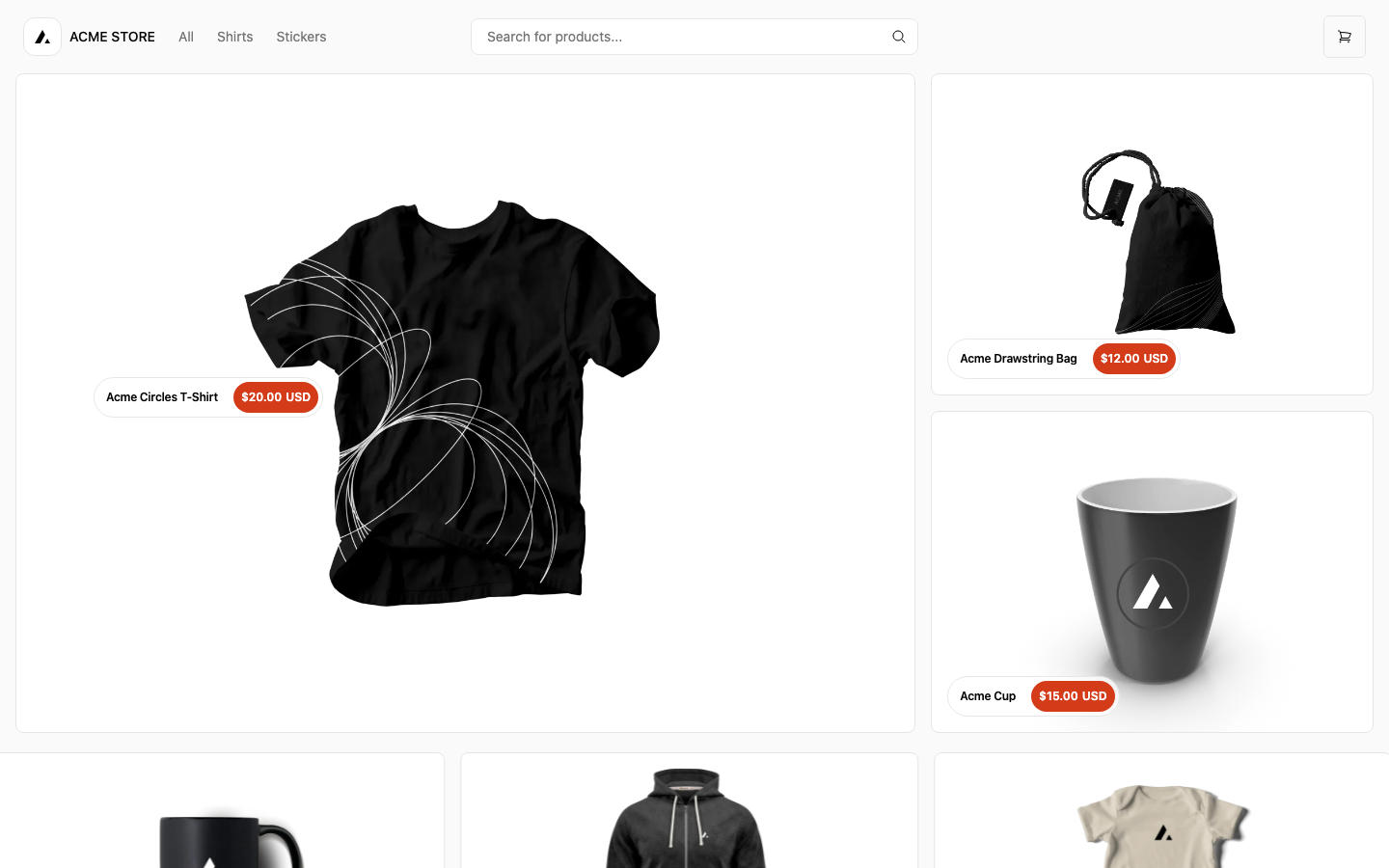
Four well-known Next.js examples follow: Acme Store, Beats, NextBooks and Drop. Each runs live on Ferrite with its original React components untouched, backed by a constrained Rust server layer built through Alloy. Applications written for TanStack Start move over along a matching path, described on the TanStack Start page.
Keeping the React component tree intact preserves the interface work teams already invested in while replacing the mutable server layer behind it. Conventional Next.js hosts run general-purpose Node servers, which leaves supply-chain patching, environment credentials and outbound network controls to each application team. Running the same front end on Ferrite removes those exposure paths by construction, because the server layer carries no shell, no environment variables and no external package graph.
Ferrite Commerce
Acme Store, Vercel's Next.js Commerce storefront on Alloy
Acme Store brings Vercel's Next.js Commerce storefront onto Ferrite behind the Ferrite Commerce example. Shoppers browse collections, search products, choose variants and manage a cart through the original React interface compiled with Alloy. Stock counts live per variant, checkout claims inventory atomically so concurrent buyers never oversell, and an exhausted variant flips to unavailable the moment the last unit moves.
Replay safety sits directly in the order operation: submitting checkout twice returns the original order record instead of duplicating it, and both orders and stock balances persist across restarts. Checkout runs through the full cart-to-order ledger without charging a payment card, so founders and engineers have a live commerce frame they can extend around their own inventory.
Beats
Persistent playback and personal libraries
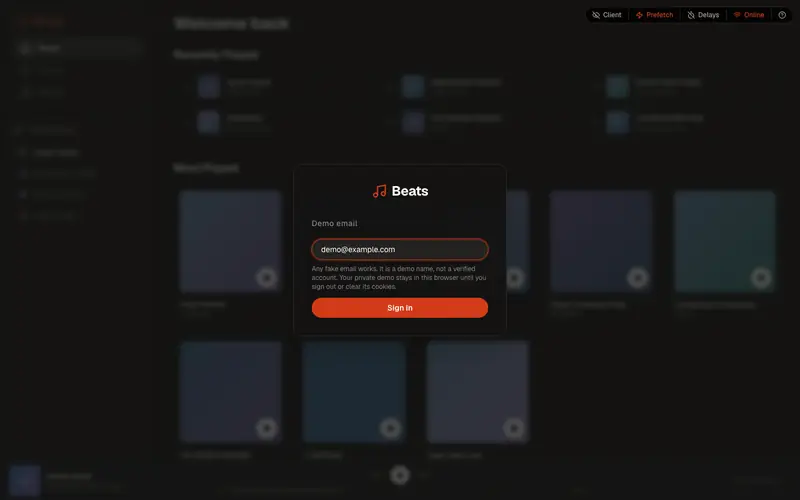
Beats began as a Vercel Next.js music player example and retains its full interactive feel on Ferrite. Listeners search the track library, star favourites, check recently played songs, and create, populate and delete playlists while the player bar keeps playing without interruption across route transitions. Any email address works at the sign-in screen.
Keeping the original React screens preserves client-side playback state, layout transitions and keyboard responsiveness as designed, while per-user libraries and playlist writes execute inside Ferrite's durable store.
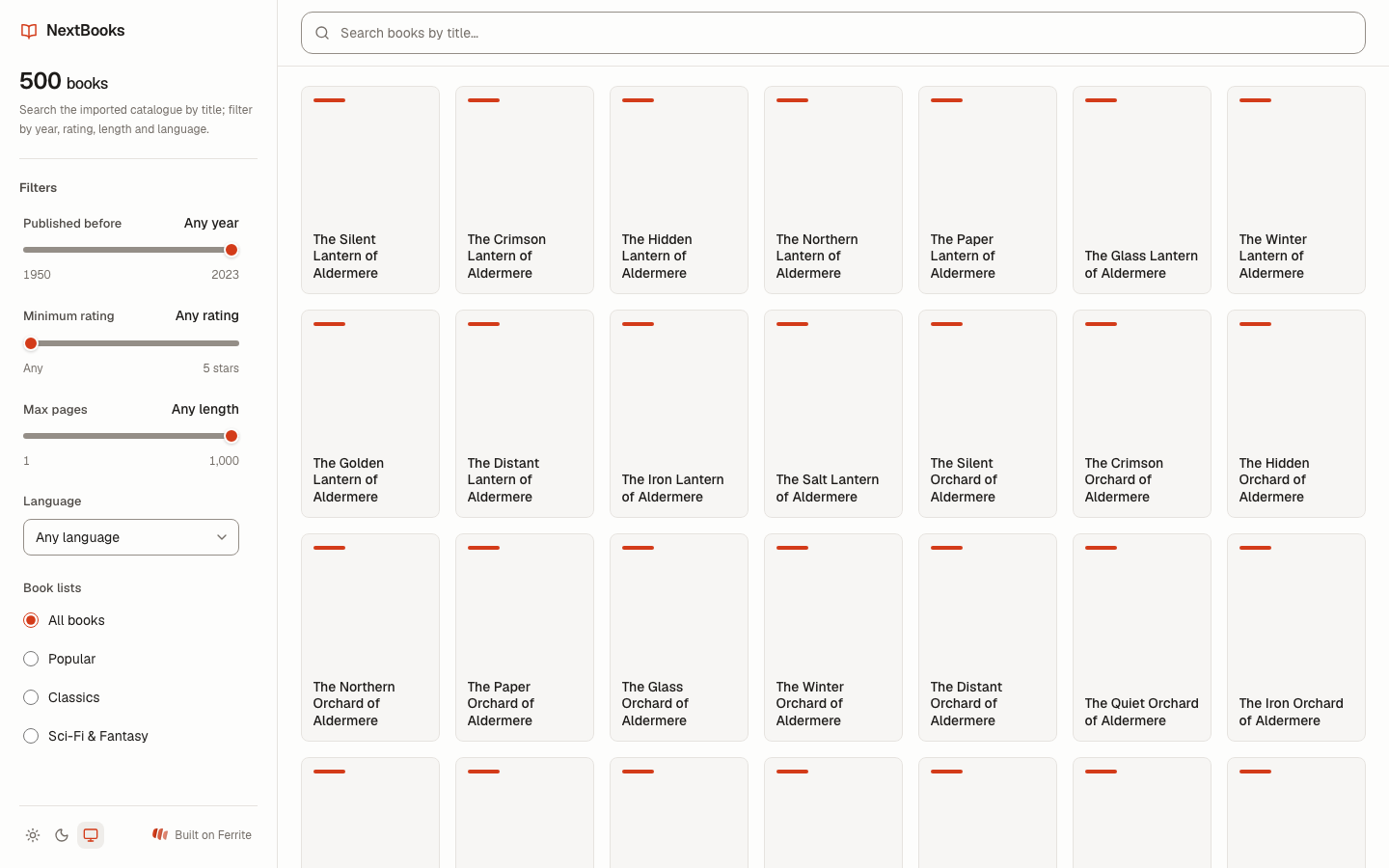
NextBooks
Multi-filter search across roughly 1.4 million books
NextBooks serves a public research catalogue of roughly 1.4 million books inside one Ferrite application. Readers filter by publication year, rating, page count and language, run title search that handles accents and word endings, paginate through matches and open dedicated book pages. Active filters live in the URL so every narrowed query can be bookmarked or shared.
Serving search over a million-plus records behind an unchanged Next.js interface requires no separate database cluster, search appliance or connection pooler to provision. Point a coding agent at your own dataset of parts, listings, recipes or research entries and it builds on the same storage and query pattern.
Drop
Optimistic updates over replay-safe server actions
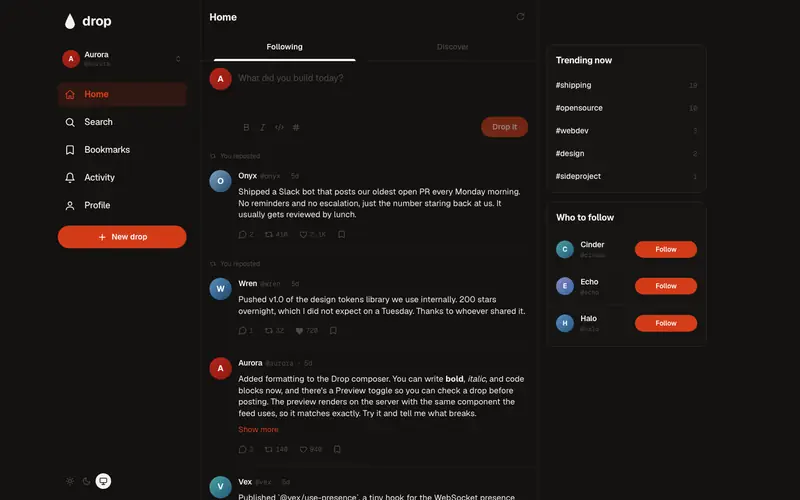
Drop started as a Next.js 16 social feed example. Members publish short posts called drops, reply in threads, like, repost, bookmark, follow accounts, browse hashtags, search and read notifications. New posts and likes appear in the interface immediately before the server answers.
Fast optimistic updates depend on strict server guarantees underneath. Replay-safe actions stop a dropped mobile connection from duplicating a post or double-counting a like, while tag-based invalidation refreshes only the feed slices touched by each write.
Shop
Catalogue pricing, stock reservation and Stripe checkout
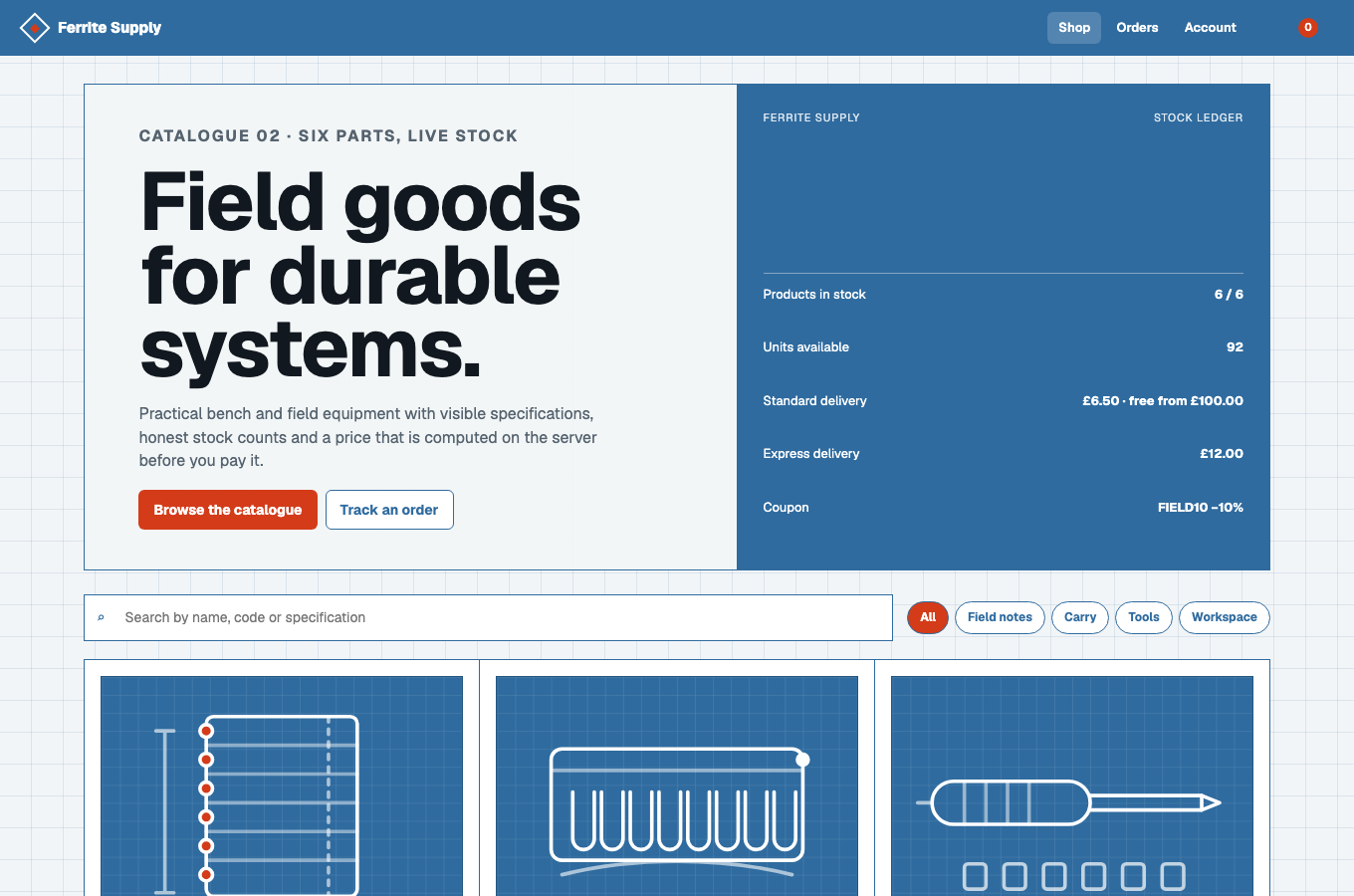
Shop runs as Ferrite Supply, a storefront for field and workshop equipment composed from Ferrite's source packages. Customers search the catalogue, choose quantities, apply coupon codes and review delivery charges before ordering. The server computes every line total, reserves stock, retains orders across reloads and restricts each order page to its own access link so another browser cannot read someone else's purchase.
Payment opens a Stripe-hosted checkout session, which the application refuses until an operator configures Stripe so funds route only to the store owner's account. Automated tests exercise the payment callback path on every change with a signed webhook fixture. Pairing payments with messaging inside one deployment shows how complete storefront capabilities fit together; the packages page lists the full catalogue.
Plan Studio
Version-checked team review for people and agents
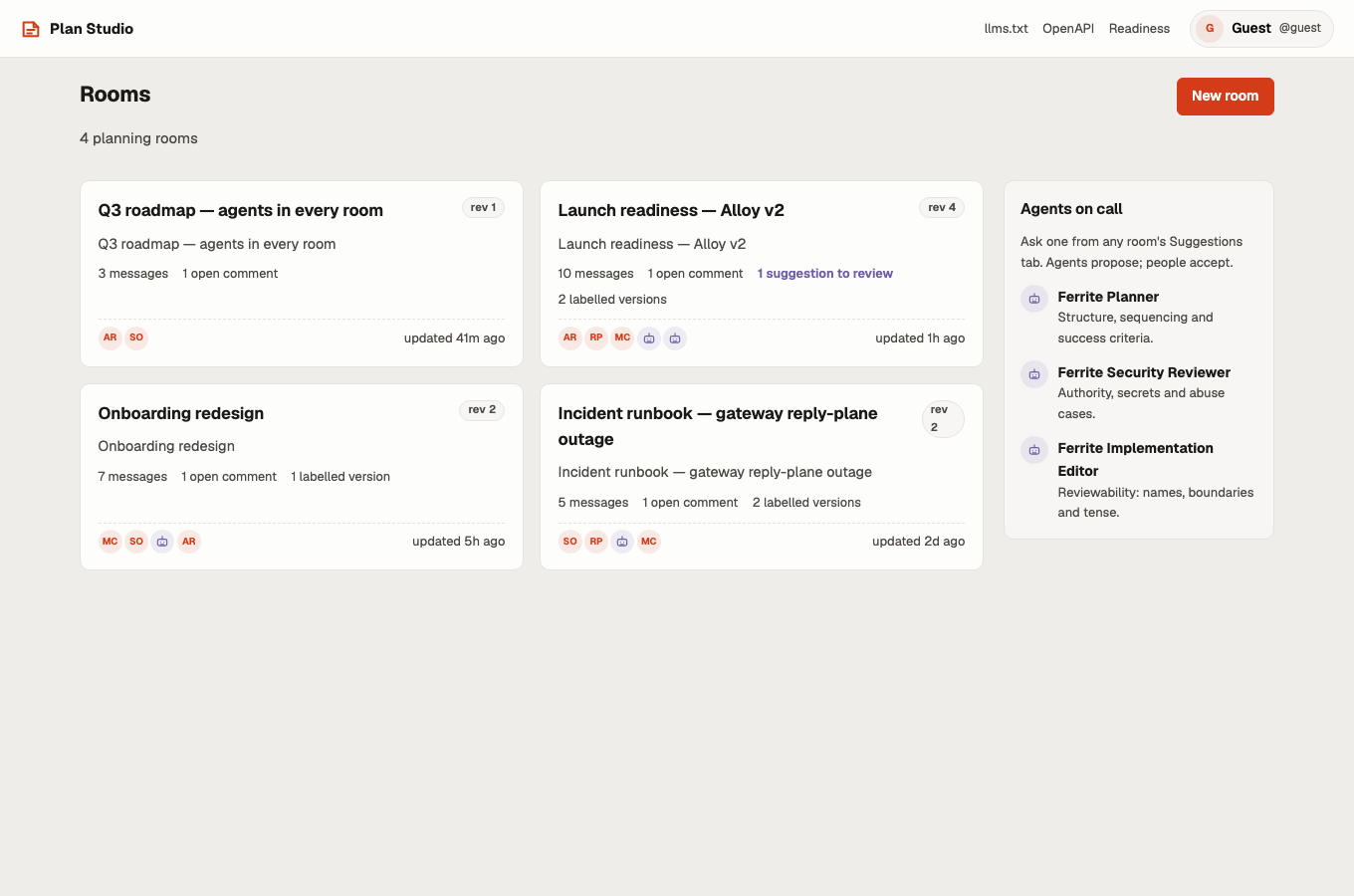
Plan Studio models collaborative workflows where a team reviews proposed edits to a specification, plan or schedule before publishing. Planning rooms hold private drafts, threaded comments, revision history and proposed changes together. Accepting a suggestion commits a new revision, and the server rejects any approval submitted against an older revision once a teammate has already published, stopping stale sign-offs. Published revisions persist in durable storage, whereas an in-progress draft survives reloads and lapses when it is left idle.
Three built-in reviewers produce deterministic example suggestions so evaluators can trace the full cycle from proposal to accepted revision. Team members in the browser and AI assistants invoking the room's tools pass through the same version checks and permissions, putting people and automated collaborators inside one shared audit trail.
One boundary for every application
A 49-application desktop, a 1.4-million-book search index, a Stripe-backed storefront and a booking studio all ship with zero custom hardening work. Because every Ferrite application compiles safe Rust against one SDK, carries no host file system or environment variables, and talks only to declared URL prefixes, containment stays identical from a tiny internal tool to a multi-user product. The security page documents every enforcement layer and the tests behind it. The sample applications are public, with source at github.com/iGentAI/ferrite-examples.
Build your own
Start with the quickstart to configure your coding agent and launch a small live application to your account. Describe your own product in plain operational terms: which records exist, which invariants must hold under concurrent traffic, and who may run each operation. Northlight Yoga is the walkthrough referenced across the rest of this site because it combines transactional state with native access for customers' AI assistants, and your coding agent can put a first version of your own product live the same day.