
Agent-ready
Open to customers and their AI assistants from day one
Customers increasingly delegate discovery, comparison, booking, and purchasing to ChatGPT, Claude, OpenClaw, and specialised personal agents. When a product exposes only pages built for human clicks, those assistants fall back to brittle scraping and abandon transactions mid-flow. On Ferrite, your product serves human browsers and customer AI assistants natively from its first deploy. You declare your operations once, and both channels execute the same handlers, transactional guarantees, and authorisation checks with no second backend to maintain.
Customer
Please make a yoga appointment for Saturday, maybe somewhere in the morning?
Their assistant
I found a class with a place at 8:30. Does that work for you?
Customer
Perfect, book it.
One operation definition, zero API drift
Treating external AI assistants as a bolt-on integration forces an engineering team to maintain two parallel surfaces: the web application that renders screens and a separate stack of MCP endpoints, OpenAPI definitions, Markdown mirrors, and payment webhooks that steadily drift out of sync. Every new business rule, pricing change, or permission boundary has to be implemented and audited twice.
Ferrite collapses those two surfaces into one. Your coding agent describes the product's pages and operations once in application code, and ferrite add agent-ready projects every discovery document and protocol endpoint directly from that one definition. When you adjust a cancellation window, update inventory logic, or introduce a new customer action, browsers and external assistants pick up the same change on the same release.
A Saturday morning class booked by an assistant
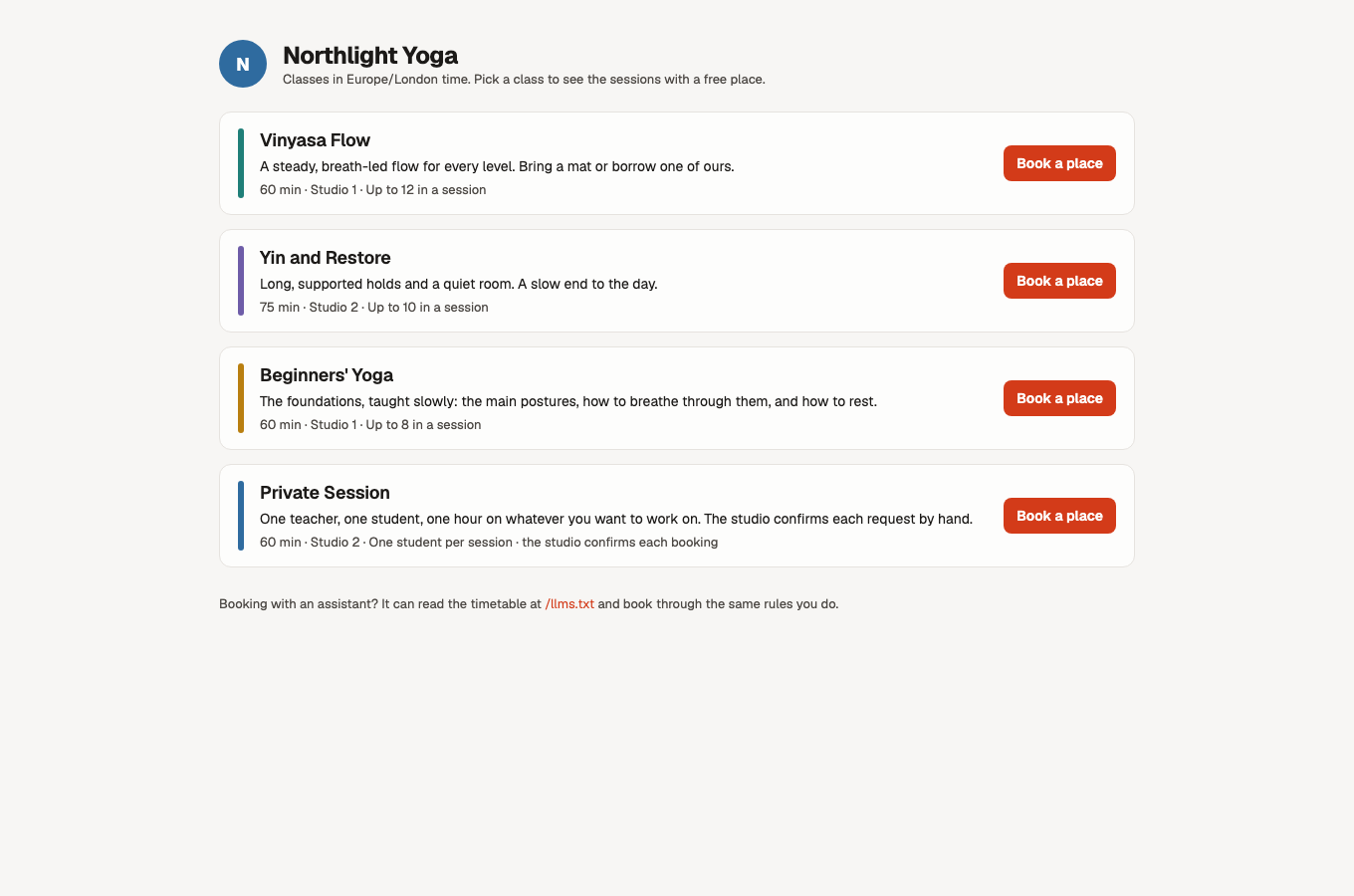
Northlight Yoga demonstrates the full interaction in production. A customer asks ChatGPT, Claude, OpenClaw, or any connected assistant to find a Saturday morning yoga class. The assistant reads the studio's discovery documents, queries live availability, presents the 8:30 session with open seats, and books the reservation once its owner confirms.
That booking writes directly to the studio's live timetable beside every browser reservation, with nothing to reconcile afterward. Confirming intent with the customer belongs to the assistant; deciding whether a seat is available, whether a hold is active, and whether the booking commits belongs strictly to the studio's application. Describe your own schedule, menu, catalogue, or workflow to your coding agent in the same domain terms, and your product behaves the same way from its initial launch.
Every assistant protocol from one package
Running ferrite add agent-ready generates the complete machine-readable surface automatically from your application's declared routes and operations:
- Orientation summaries at
llms.txtand complete corpus output atllms-full.txt, so any assistant gets full context on its first fetch. - Clean Markdown twins of every page via
.mdURLs and standard HTTPAccept: text/markdowncontent negotiation. - A machine-readable OpenAPI catalogue at
/.well-known/api-catalogspecifying schemas, inputs, and constraints. - Agent cards and Agent2Agent (A2A) discovery metadata describing application capabilities and request endpoints.
- Direct tool execution over
/mcpthat routes assistant tool calls into the same typed handlers as your HTTP endpoints. - Personal Agent Protocol (Poppy 1.0) discovery at
/.well-known/poppy.json, exposure-filtered OpenAPI and MCP views,/poppy/tasksskill indexes and excluded tasks, exact-terms confirmation gates (operationsv3), 3-step Browser Join, and structured conversations. - Structured pricing metadata and x402 payment requests for paid operations an assistant can settle programmatically.
- RFC 9457 problem documents on every refusal with machine-parseable error types and reasons an assistant can relay plainly to its owner.
This website runs on the same package: every page has a live Markdown twin and is published through its own llms.txt, OpenAPI catalogue, and MCP endpoint. As external assistant conventions evolve, updating the agent-ready package carries every application forward without rewriting domain rules. For the coding-agent side of the lifecycle, see building with coding agents.
Personal Agent Protocol (Poppy 1.0) with isolated per-app sign-in
When a customer's personal agent speaks the Personal Agent Protocol (Poppy 1.0), your application opts in by returning a PoppyConfig alongside its Surface declaration. From that declaration, agent-ready publishes /.well-known/poppy.json, RFC 9728 Protected Resource Metadata, an exposure-filtered /poppy/openapi.json, /poppy/tasks, and POST /poppy/feedback without a separate gateway or middleware stack.
Every declared operation carries an explicit exposure policy so you decide exactly what external personal agents can see and invoke:
- Public operations remain open to signed-out discovery and execution.
- Signed-in operations declare the OAuth scopes a customer must consent to before an agent can call them.
- Consequential writes opt into exact-terms confirmation (
operationsv3), issuing a signed revision over the canonical terms and executing at most once after the customer approves. - Internal operations stay completely out of
/poppy/openapi.jsonand are filtered out of/mcpwhenever aPoppy-Sessionheader is present, while remaining available to your own web interface.
Every Ferrite application keeps its own isolated OAuth 2.1 issuer so customer products never share a single platform issuer or bleed grants across businesses. Run a self-contained per-app issuer directly inside your application with ferrite add poppy-oauth (covering PAR, PKCE S256, signed JWT client assertions, multi-resource RFC 8707 refresh tokens, optional DPoP, immediate RFC 7009 revocation, and a Connected Personal Agents settings page), or point Poppy discovery at your existing external OAuth provider such as Auth0, WorkOS, Clerk, or Okta. For products with a browser UI or a built-in company assistant, the same package provides CSRF-safe 3-step Browser Join and structured Poppy conversations with human handoff.
Verify assistant readiness before launch
Every agent-ready application exposes a live diagnostic report at /.well-known/agent-readiness. The report verifies discovery files, schemas, endpoints, content negotiation, and refusal formatting, and lists any missing detail alongside the required fix. Your coding agent reads that report before promotion so you ship knowing external assistants can discover, inspect, and execute complete workflows reliably.
Containment holds across human and agent traffic
On conventional infrastructure, exposing an MCP server and public agent endpoints creates a new network perimeter to monitor, patch, and isolate. On Ferrite, the agent surface runs inside the same compiled binary and the same ferrite.json capability manifest as the web interface. Every Ferrite application runs safe by construction and by default, with nothing to assemble. Even a malformed or adversarial request from an external assistant encounters a process with no shell, no host filesystem, no environment variables, signed resource-scoped storage tokens, and egress restricted to literal declared prefixes. Full architectural details and hostile-input tests live on the security page.
Reach customers directly inside ChatGPT and Codex
Products built on Ferrite can also meet customers inside ChatGPT and Codex natively. Running ferrite add gpt-plugins assembles the submission-ready plugin directly from the operations your application already declares. A reservation or purchase submitted from inside ChatGPT executes through the same transactional locks, inventory checks, and permission rules guarding every other channel.